

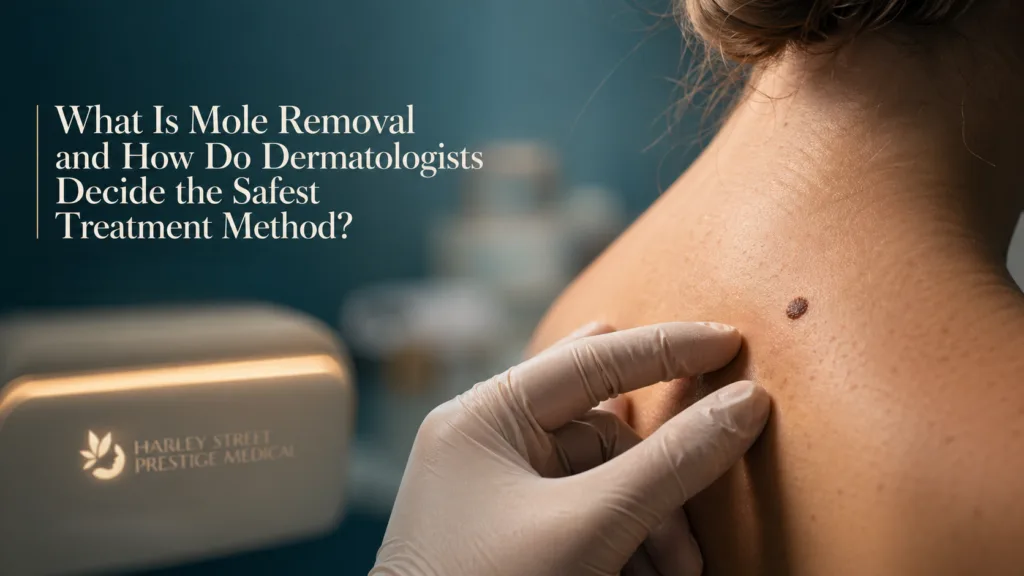
Skin moles are something most of us have, often without giving them much thought. They can be small, flat, raised, light, or dark and in most cases, they’re completely harmless. But when a mole changes, becomes bothersome, or simply affects your confidence, it’s natural to start asking questions. What exactly is mole removal? And more importantly, how do dermatologists decide the safest way to remove one?
Let’s walk through it from your perspective so you understand not just the “what,” but the “why” behind every decision.
What Is a Mole?
A mole, or melanocytic nevus, forms when melanocytes (pigment-producing cells in the skin) cluster together. These cells produce melanin, the pigment responsible for your skin color.
Moles can:
- Appear at birth or develop over time
- Be flat or raised
- Vary in color from light brown to almost black
- Stay stable for years or evolve gradually
Most adults have between 10 to 40 moles, and the majority are benign (non-cancerous). However, because melanocytes are also involved in melanoma (a serious type of skin cancer), any change in a mole deserves attention.
What Is Mole Removal?
Mole removal is a dermatological procedure performed to eliminate a mole for either medical or cosmetic reasons.
From a clinical standpoint, removal may be recommended when:
- A mole shows suspicious changes
- There’s a need for histopathological examination (lab testing)
- It causes irritation (e.g., from clothing or shaving)
From a patient’s perspective, removal is often about:
- Improving appearance
- Boosting confidence
- Eliminating discomfort
The key thing to understand is this: mole removal is not a one-size-fits-all procedure. The method used depends heavily on how the mole behaves and its appearance under professional evaluation.
When Should You Consider Getting a Mole Checked?
Before talking about removal, dermatologists focus on assessment. Not every mole needs to be removed, but some definitely need to be examined, particularly if you are considering mole removal treatment in London and want expert reassurance.
You should consider a professional evaluation if you notice:
- A mole changing in size, shape, or color
- Irregular or blurred borders
- Multiple colors within the same mole
- Itching, bleeding, or crusting
- A mole that looks different from others
Dermatologists often use the ABCDE rule:
A – Asymmetry
B – Border irregularity
C – Color variation
D – Diameter (usually > 6 mm)
E – Evolving over time
These features help determine whether a mole is benign, atypical, or potentially malignant.
How Dermatologists Evaluate a Mole
From your side, it may feel like a quick consultation, but clinically, there’s a structured approach behind it.
Dermatologists assess:
- Morphology (shape, color, texture)
- Dermatoscopic patterns (using a dermatoscope for magnified evaluation)
- Patient history (when it appeared, changes over time, symptoms)
- Risk factors (family history, sun exposure, skin type)
This evaluation helps answer the most important question:
Is this mole safe to monitor, or should it be removed?
How Dermatologists Decide the Safest Removal Method
Once removal is considered, the choice of technique is guided by medical safety first, followed by cosmetic outcome. At a reputable Harley Street dermatology clinic in London, this decision is always personalised.
Here are the main methods and how doctors decide between them:
Surgical Excision
What it is:
The mole is completely removed using a scalpel, along with a small margin of surrounding tissue. The wound is then closed with stitches.
When it’s chosen:
- Suspicious or atypical moles
- Lesions requiring histological analysis
- Deep or irregular moles
Why dermatologists prefer it in certain cases:
This method ensures complete removal and allows the tissue to be sent to a laboratory for microscopic examination. It’s the safest option when there’s any concern about malignancy.
From your perspective:
You may have a small scar, but you gain peace of mind knowing the mole has been fully evaluated.
Shave Removal
What it is:
The mole is shaved off at the level of the skin using a surgical blade.
When it’s chosen:
- Raised, benign moles
- Cosmetic concerns
- Moles that don’t show suspicious features
Why it’s used:
It’s less invasive than excision and often results in a good cosmetic outcome.
Limitations:
- Not suitable for suspicious moles
- May not remove deeper cells completely
- Slight risk of recurrence
From your perspective:
Quick procedure, minimal downtime, but only appropriate when the mole is clearly benign.
Cryotherapy
What it is:
The lesion is frozen using liquid nitrogen, causing the tissue to break down.
When it’s chosen:
- Certain benign skin lesions (not all moles)
Why dermatologists are cautious:
Cryotherapy is generally not recommended for pigmented moles because it doesn’t allow for histological examination and may obscure diagnosis.
From your perspective:
It might sound simple, but it’s not always the safest option, especially for pigmented lesions.
The Role of Histology
Histology (laboratory analysis of removed tissue) plays a crucial role in mole removal.
- Confirms whether the mole is benign or malignant
- Provides peace of mind
- Guides further treatment if needed
Not every mole requires histology, but dermatologists will recommend it whenever there’s uncertainty.
What Factors Influence the Decision?
Dermatologists don’t just look at the mole; they consider the whole picture:
- Location: Face vs. body (cosmetic importance and healing)
- Size and depth: Determine how invasive the procedure should be
- Patient preference: Cosmetic goals and tolerance for scarring
- Skin type: Healing patterns and risk of pigmentation changes
- Medical necessity: Suspicion of malignancy always takes priority
This individualized approach ensures that treatment is both safe and appropriate for you.
What to Expect During and After the Procedure
The process is usually straightforward.
During the procedure:
- Local anesthesia is used
- The procedure typically takes 15–30 minutes
- Minimal discomfort
Aftercare:
- Keep the area clean and protected
- Follow wound care instructions carefully
- Monitor for signs of infection
Healing time varies depending on the method used, but most people resume normal activities quickly.
Can Moles Be Prevented?
While you can’t completely prevent moles, you can reduce risks associated with changes:
- Use broad-spectrum sunscreen regularly
- Avoid excessive sun exposure
- Perform routine skin checks
- Seek early evaluation for any changes
Prevention isn’t about eliminating moles; it’s about staying aware and proactive.
The Importance of Choosing the Right Mole Removal Clinic
Choosing the right mole removal clinic is just as important as the procedure itself. Clinics with experienced dermatology professionals are better equipped to:
- Accurately assess risk
- Choose an appropriate treatment
- Ensure safe and aesthetically mindful outcomes
At Harley Street Prestige Medical, a leading Harley Street dermatology clinic in London, care is centred around the patient, combining medical expertise with aesthetic excellence to achieve optimal outcomes.
Seek Expert Advice Today
If you are considering mole removal treatment in London, booking a consultation is the first step towards clarity and reassurance. Book your consultation with Harley Street Prestige Medical today and receive a comprehensive mole assessment designed around your individual needs, delivered with precision, discretion, and expert care.

