

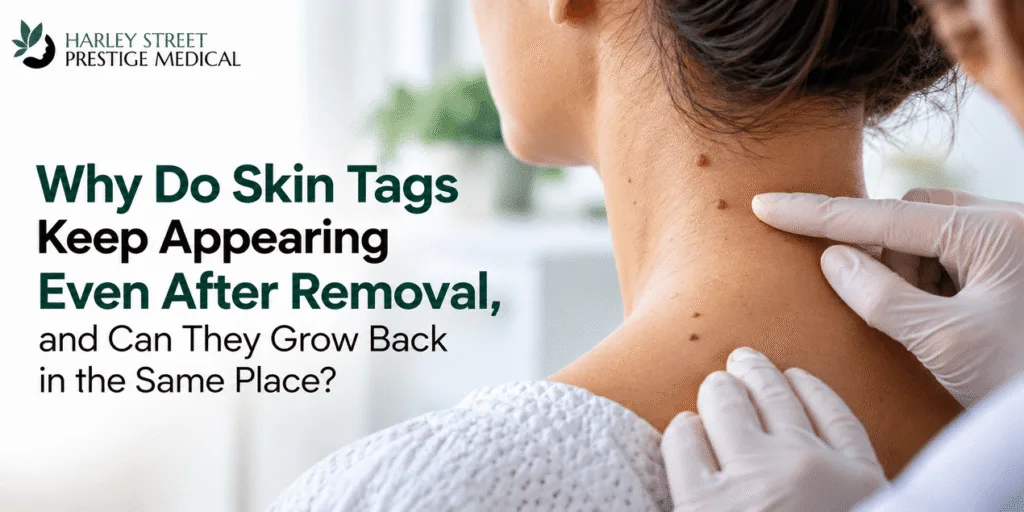
I’ve had a few skin tags removed, but they keep coming back. Is there a way to remove them permanently?
You finally had that annoying skin tag removed, only to spot another one a few weeks or months later. It can feel like you are back where you started. But there is a reason this can happen, and it does not necessarily mean the original treatment was unsuccessful.
In this guide, we look at why new skin tags can appear after removal, whether they can develop in the same place, how doctors remove them, and what you can expect from professional treatment at Harley Street Prestige Medical.
Why Am I Getting Skin Tags?
If you are wondering what skin tags are, they are soft, benign growths made up of collagen fibres, small blood vessels, and surrounding skin tissue. They commonly develop where there is repeated friction, skin-to-skin contact, or moisture.
This is why you may notice skin tags on neck, under the arms, around the eyelids, groin, under the breasts, chest, and upper torso.
The causes of skin tags can vary from person to person. Factors associated with their development include age, genetics, hormonal changes, increased skin folds, obesity and certain metabolic factors such as insulin resistance and diabetes.
Pregnancy can also be associated with the development of skin tags, partly because of hormonal changes and changes in the skin during pregnancy.
So, if you have had one skin tag removed, this does not necessarily mean that your skin has stopped forming them. Removal treats the existing lesion; it does not eliminate the underlying tendency to develop new skin tags.
Why Do Skin Tags Keep Coming Back?
This is one of the most common concerns patients have after treatment.
In many cases, what appears to be a “recurrence” is actually a new skin tag developing in the same general area. Skin tags tend to occur in predictable locations where friction, moisture or skin folds are present.
For example, if a skin tag is removed from the neck, continued friction from collars, jewellery or adjacent skin may contribute to the development of another lesion nearby.
There is also an important distinction between recurrence and incomplete removal.
After complete removal, a treated skin tag would not usually be expected to regrow. However, new skin tags can develop in the same area or close to the previous treatment site, which can sometimes appear to be recurrence. If tissue remains at the treatment site, however, what looks like recurrence may require clinical assessment to determine exactly what has developed.
For this reason, a new growth should not automatically be assumed to be the same skin tag returning.
Can a Skin Tag Grow Back in the Same Place?
After complete removal, a treated skin tag would not usually be expected to regrow. However, new skin tags can develop in the same area or close to the previous treatment site, which can sometimes appear to be recurrence.
The distinction matters clinically.
If you notice a new growth after removal, particularly if it is changing in colour, becoming painful, bleeding or developing an unusual appearance, it should be examined by an appropriately qualified medical professional rather than assumed to be a recurrent skin tag.
At our Harley Street Skin Clinic, our specialists assess the lesion before recommending treatment. This helps determine whether it is consistent with a benign skin tag or whether further investigation is appropriate.
How Does a Dermatologist Remove Skin Tags?
If you are researching how to remove skin tags, the appropriate treatment depends on the size, location, morphology and number of lesions, as well as your individual circumstances.
At our Harley Street Skin Clinic, we offer two principal approaches: surgical excision and hyfrecation (electrosurgical removal).
Excision Removal
Excision involves removing the skin tag using a precise surgical technique, usually after administering a local anaesthetic.
Because the treatment area is numbed, the procedure is generally well tolerated. The clinician carefully removes the lesion while aiming to minimise trauma to the surrounding skin.
Excision may be particularly appropriate for:
- Larger skin tags
- Pedunculated or raised lesions
- Irritated lesions
- Lesions requiring precise removal
- Cases where tissue may be appropriate for histological assessment
Where clinically indicated, the removed tissue can be sent for histopathological examination. This provides additional diagnostic information when there is uncertainty about the nature of a lesion.
Hyfrecation (Electrosurgical Removal)
Hyfrecation uses controlled electrical energy to cauterise and remove suitable small or superficial lesions.
It can be useful for smaller skin tags and cosmetically sensitive areas where precision and control are particularly important.
Skin tags removal treatment is usually performed under local anaesthetic. Because the technique can provide controlled haemostasis, it may also help minimise bleeding during the procedure.
Your clinician will determine whether excision or hyfrecation is appropriate after assessing the lesion.
Is Skin Tag Removal Painful?
You may be concerned about pain before treatment.
Most skin tag removal procedures are performed under local anaesthetic, which numbs the treatment area while you remain awake. You may feel the initial injection of the anaesthetic, but once the area is numb, the removal itself is generally associated with minimal discomfort.
The procedure is also usually relatively quick, although treatment time depends on the number, size and location of the lesions.
When Should I Have a Skin Tag Checked?
Although skin tags are usually benign, not every skin growth is a skin tag.
You should seek medical assessment if a lesion:
- Appears suddenly or grows rapidly
- Changes colour or shape
- Becomes painful
- Bleeds repeatedly
- Becomes unusually firm
- Develops an irregular appearance
- Changes noticeably over time
A clinical examination can help distinguish a typical skin tag from other benign or potentially concerning skin lesions. This is particularly important if you are uncertain whether a growth is actually a skin tag.
Can I Prevent New Skin Tags From Developing?
There is no guaranteed way to prevent skin tags completely, particularly when genetics and age play a role.
You can reduce skin irritation by wearing loose clothing, maintaining a healthy weight, keeping skin folds clean and dry, and managing conditions such as diabetes with appropriate medical care.
A cosmetic dermatologist in Harley Street can provide personalised advice if new skin tags continue to develop.
Where to Go for Skin Tag Removal?
If you are looking for safe and professional skin tag removal in London, Harley Street Prestige Medical offers personalised assessment and treatment by experienced medical professionals.
Our GMC-registered doctors and experienced skin specialists assess each skin tag carefully before recommending the most appropriate removal method. The treatment approach is based on factors such as the skin tag’s size, location, and appearance.
Our approach includes:
- Thorough clinical assessment
- Treatment performed using appropriate infection prevention and control measures
- Local anaesthesia for comfort
- Precise skin tag removal
- Histological analysis where clinically appropriate
- Careful treatment to minimise unnecessary trauma
- Clear aftercare advice
Same-day appointments may also be available where clinically appropriate. If a skin tag is irritating you, affecting your confidence, or simply something you would like removed, contact Harley Street Prestige Medical to arrange a consultation and discuss your treatment options with a qualified specialist.

