

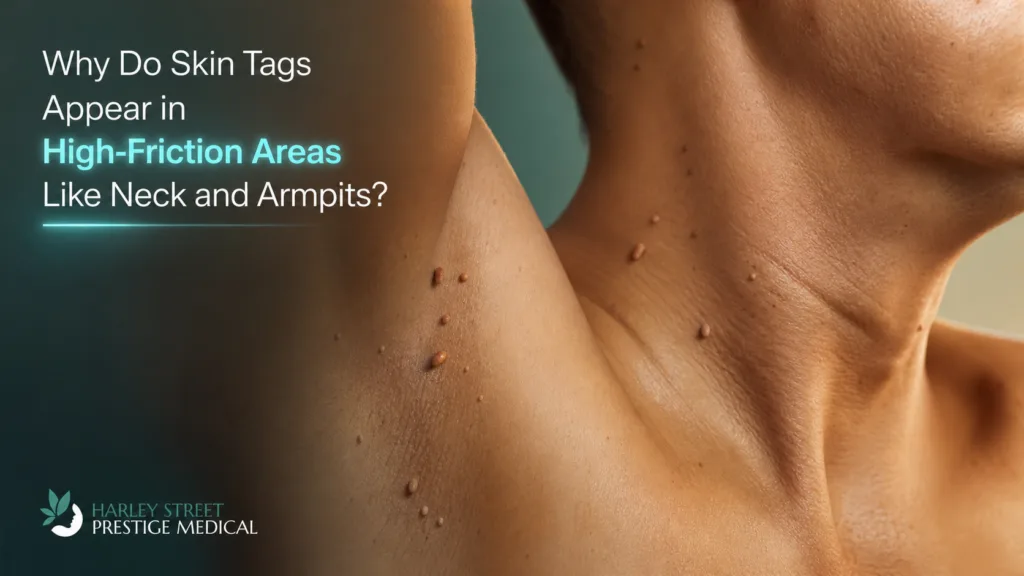
Skin tags, medically known as acrochordons, are extremely common, benign skin growths that many people notice at some point in their lives. They often appear in places like the neck, armpits, groin, and under the breasts. One of the most interesting patterns about skin tags is their strong tendency to develop in high-friction areas. But why does this happen?
Let’s break it down.
What Is a Skin Tag?
A skin tag is a soft, small growth that typically hangs off the skin by a thin stalk (called a peduncle). It is made up of loose collagen fibres and small blood vessels, and is covered by normal skin.
Skin tags affect nearly 25–46% of adults, making them one of the most common benign skin growths seen in clinical practice (Source: StatPearls, NCBI).
They are:
- Non-cancerous (benign)
- Usually painless
- Skin-coloured or slightly darker
- Variable in size (from a few millimetres to several centimetres)
Even though they are harmless, they can become bothersome depending on their size or location.
Why Are High-Friction Areas More Affected?
The key factor behind skin tag formation in areas like the neck and armpits is mechanical friction.
Constant Skin-to-Skin Rubbing
In areas like the armpits or neck folds, skin is frequently rubbing against itself. This repeated friction can cause:
- Micro-irritation
- Minor skin trauma
- Local inflammation
Over time, this repeated irritation stimulates excess growth of skin tissue, leading to the formation of a skin tag.
Skin-to-Clothing Friction
Tight clothing, collars, bras, or jewelry can continuously rub against certain parts of the skin. This is especially common in:
- Necklines (collars, chains)
- Underarms (tight sleeves)
- Waistbands
This external friction adds to internal skin rubbing, increasing the likelihood of skin tag development.
Warm and Moist Environment
Areas like the armpits are naturally:
- Warm
- Moist
- Poorly ventilated
This environment weakens the skin barrier and makes it more prone to irritation and minor injury, both of which contribute to skin tag formation.
The Role of Collagen and Blood Vessels
From a medical perspective, friction triggers a localized response in the skin. The body reacts by:
- Producing more collagen
- Expanding small blood vessels
This results in a small outgrowth of tissue, which we recognize as a skin tag.
Think of it as the skin’s way of responding to repeated stress.
Other Contributing Factors
While friction is a major trigger, it usually works alongside other underlying factors:
Genetics
Some individuals are simply more prone to developing skin tags due to inherited traits.
Hormonal Changes
Hormonal fluctuations, especially during pregnancy, can increase skin tag formation.
Obesity
Increased body weight leads to:
- More skin folds
- More friction
- Higher insulin levels
All of these contribute to skin tag development.
Insulin Resistance and Diabetes
There is a strong association between skin tags and metabolic conditions like insulin resistance. Elevated insulin levels may stimulate abnormal skin growth.
Age
Skin tags become more common as people get older, likely due to cumulative skin friction and biological changes.
Skin tags are more frequently observed after the age of 40, with prevalence increasing over time. (Source: American Academy of Dermatology)
Why Neck and Armpits Specifically?
Let’s look at these areas individually:
Neck
- Constant movement (turning, bending)
- Friction from collars and jewelry
- Natural skin folds
Armpits
- Continuous arm movement
- Skin-to-skin contact
- Sweat and moisture
These conditions make both areas ideal environments for skin tags to develop.
When Should You Be Concerned?
Although skin tags are harmless, it’s important to seek medical advice if you notice:
- Rapid growth
- Pain or bleeding
- Change in colour or shape
- Very large size
A proper clinical assessment ensures that the growth is indeed a skin tag and not another skin condition.
Professional Skin Tag Removal Options
At our Harley Street skin care clinic, skin tag removal is treated as a minor, safe, and highly effective medical procedure.
We offer two primary treatment options:
Excision (Most Common)
- Performed under local anaesthetic
- Skin tag is carefully removed using a scalpel
- Quick and precise
- Ideal for larger or deeper tags
Cryotherapy
- Uses extreme cold to freeze the skin tag
- Suitable for small, superficial tags
- Non-invasive option
The right skin tag treatment is chosen based on size, location, and number of skin tags.
Is the Procedure Painful?
Not really.
The procedure is done under local anaesthesia, which means:
- The area is numbed
- You remain fully awake
- No significant discomfort is felt
Most patients describe it as quick and manageable.
Recovery and Aftercare
Recovery is typically straightforward:
- Minimal downtime
- Keep the area clean and dry
- Follow simple aftercare instructions
Healing is usually quick, and complications are rare when performed by experienced professionals.
Will Skin Tags Come Back?
Once a skin tag is properly removed, it is unlikely to return in the same spot.
At the Harley Street skin care clinic, patients are also offered a 12-month excision guarantee, reflecting confidence in long-term results.
However, new skin tags can still develop in other areas if underlying factors like friction or metabolic conditions persist.
Why Consider Removal?
Many people choose skin tag removal treatment in London for the following reasons:
Cosmetic Concerns
Visible skin tags, especially on the neck, can affect confidence.
Irritation and Discomfort
Tags in high-friction areas can:
- Catch on clothing
- Become painful
- Bleed if irritated
Preventive Care
Removing a problematic skin tag early can prevent future discomfort or complications.
Expert Skin Tag Removal Treatment in London
When it comes to safe and effective skin tag treatment, choosing the right clinic makes all the difference. At Harley Street Prestige Medical, every procedure is carried out with a strong focus on both medical precision and cosmetic outcome.
Our team of experienced clinicians carefully assess each case to select the most suitable technique, ensuring complete removal while minimising any risk of scarring. Even complex or sensitive cases are managed with specialist support, giving patients added confidence in their care. With the option of same-day procedures and a patient-focused approach, the clinic delivers outcomes that prioritise both clinical safety and aesthetic precision. Ready to get rid of unwanted skin tags? Book your consultation today and experience expert-led skin tag removal treatment in London at Harley Street Prestige Medical.

