

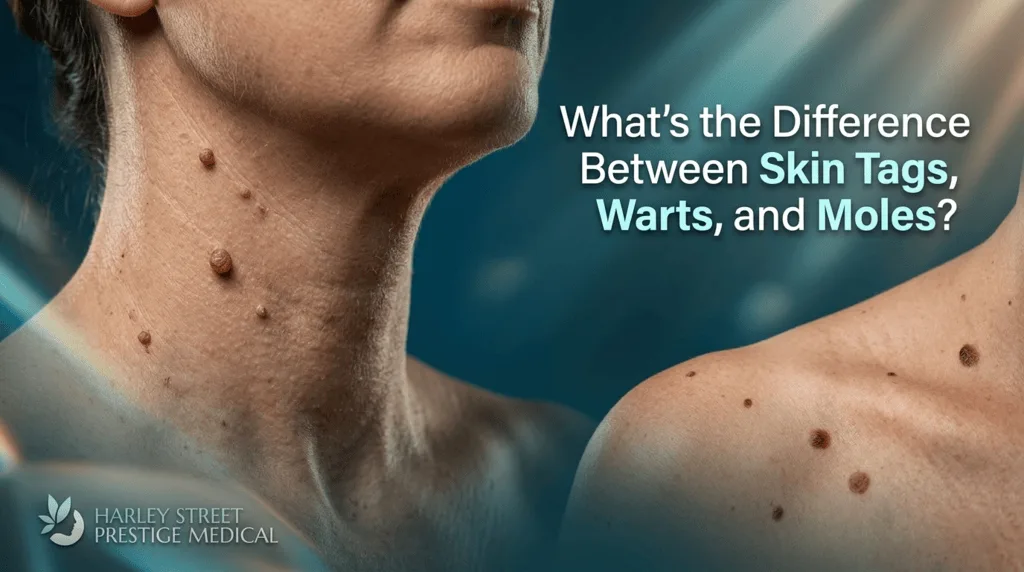
Skin growths are extremely common and, in most cases, completely benign. However, many people find it difficult to distinguish between skin tags, warts, and moles. While these lesions may appear similar at first glance, they differ considerably in their cause, appearance, behaviour, and treatment options.
Understanding these differences is important not only for cosmetic reasons but also for your long-term skin health. Some lesions require monitoring, others may spread if left untreated, and certain changes can indicate the need for further medical assessment.
At Harley Street skin care clinic, our experienced clinicians regularly assess and remove skin tags, warts, and moles, helping patients achieve reassurance and optimal aesthetic results.
Understanding Common Skin Lesions
Before considering treatment, it is important to identify exactly what type of skin lesion you have. Accurate diagnosis allows for the safest and most effective treatment plan.
Although skin tags, warts, and moles are generally benign, they each develop for different reasons and require different clinical approaches.
What Are Skin Tags?
Skin tags, medically known as acrochordons, are soft, harmless growths of skin that commonly develop in areas of friction.
They are composed of loose collagen fibres and small blood vessels covered by normal skin tissue. Skin tags often appear attached to the skin by a narrow stalk known as a peduncle.
Although skin tags are benign and non-cancerous, some individuals choose to seek skin tag removal treatment in London if they become irritated, affect self-confidence, or interfere with daily activities.
Common Characteristics of Skin Tags
Skin tags are typically:
- Soft and flesh-coloured
- Small and flexible
- Painless
- Attached by a thin stalk
- Found in skin folds and high-friction areas
Where Do Skin Tags Commonly Appear?
Skin tags frequently develop on the:
- Neck
- Underarms
- Eyelids
- Groin
- Under the breasts
- Chest and upper torso
Why Do Skin Tags Develop?
Several factors may contribute to skin tag formation, including:
- Repeated skin friction
- Genetics
- Ageing skin
- Obesity
- Insulin resistance
- Diabetes
- Hormonal changes
- Pregnancy
Although skin tags are harmless, they can become irritated by clothing, jewellery, shaving, or everyday movement, leading many patients to seek professional treatment for skin tags to improve comfort and achieve optimal cosmetic results.
What Are Warts?
Warts are benign skin growths caused by infection with the Human Papillomavirus (HPV).
Unlike skin tags, warts are contagious and can spread from person to person or to other areas of the body. There are over 100 different HPV strains, each capable of causing different types of warts.
Common Characteristics of Warts
Warts are typically:
- Rough or thickened in texture
- Firm to touch
- Raised above the skin surface
- Skin-coloured or slightly darker
- Contagious
Common Locations for Warts
Warts can develop almost anywhere but are most commonly found on:
- Hands
- Fingers
- Feet (plantar warts)
- Knees
- Elbows
- Face
- Genital area
Why Do Warts Develop?
Warts occur when HPV enters the skin through tiny breaks or abrasions.
The virus stimulates excessive growth of skin cells, resulting in the characteristic wart appearance.
Risk factors include:
- Direct skin-to-skin contact
- Shared towels or personal items
- Public swimming pools
- Compromised immunity
- Skin trauma
Because HPV remains within infected skin cells, professional treatment is often required to achieve complete removal.
What Are Moles?
Moles, also known as melanocytic naevi, develop when pigment-producing cells called melanocytes cluster together within the skin.
Most moles are completely benign and remain stable throughout life. However, unlike skin tags and warts, moles require careful monitoring because certain changes may indicate the development of skin cancer.
Common Characteristics of Moles
Moles are generally:
- Brown, tan, black, or flesh-coloured
- Flat or raised
- Round or oval in shape
- Symmetrical
- Uniform in colour
Some moles may also contain hair growth.
Where Do Moles Commonly Appear?
Moles can occur anywhere on the body but are particularly common on:
- Face
- Chest
- Back
- Arms
- Legs
- Sun-exposed areas
Why Do Moles Develop?
Several factors contribute to mole formation, including:
- Genetics
- Ultraviolet (UV) exposure
- Skin type
- Hormonal influences
Most moles remain unchanged over time. However, any mole that begins to evolve should be professionally assessed.
Skin Tags vs. Warts vs. Moles: Key Differences
| Feature | Skin Tag | Wart | Mole |
| Cause | Friction, genetics, hormonal factors | Human Papillomavirus (HPV) | Melanocyte clustering |
| Appearance | Soft, hanging growth | Rough, thickened bump | Pigmented spot or raised lesion |
| Texture | Soft and smooth | Rough and firm | Smooth or slightly raised |
| Colour | Flesh-coloured | Skin-coloured or slightly darker | Brown, tan, black, pink |
| Contagious | No | Yes | No |
| Typical Locations | Neck, underarms, groin | Hands, feet, fingers | Anywhere on the body |
| Cancer Risk | Very low | Very low | Some moles require monitoring |
When Should You Seek Medical Assessment?
Although many skin lesions are harmless, professional evaluation is recommended if you notice:
For Moles:
- Changes in size
- Changes in shape
- Colour variation
- Bleeding
- Itching
- Crusting
- Irregular borders
The widely recognised ABCDE guide can help identify concerning changes:
A – Asymmetry
B – Border irregularity
C – Colour variation
D – Diameter enlargement
E – Evolution or change over time
For Warts:
- Rapid spreading
- Pain
- Bleeding
- Resistance to treatment
- Recurrence after removal
For Skin Tags:
- Sudden growth
- Colour changes
- Recurrent bleeding
- Persistent irritation
- Cosmetic concerns
Any new or changing lesion should be assessed by an experienced clinician to ensure an accurate diagnosis.
Expert Skin Lesion Removal on Harley Street, London
Whether you are concerned about a mole, struggling with persistent warts, or looking to remove bothersome skin tags, obtaining an accurate diagnosis is the first and most important step.
At Harley Street skin care clinic, we provide expert assessment and removal of:
- Moles
- Warts
- Skin tags
Our GMC-registered clinicians combine medical expertise with advanced treatment techniques to deliver safe, effective, and aesthetically focused outcomes.
Every patient receives a personalised consultation, thorough clinical assessment, and a treatment plan designed around their individual needs.
Professional Treatment Options
The most appropriate treatment depends on the type of lesion, its location, and the clinical assessment findings.
Mole Removal
Treatment options may include the following:
- Surgical excision
- Shave removal
- Cryotherapy
Wart Removal
Treatment options may include the following:
- Surgical excision
- Hyfrecation (electrocautery treatment)
- Cryotherapy (freezing treatment)
- Medical / topical treatments
Skin Tag Removal
Treatment options may include the following:
- Excision (Most Common)
- Cryotherapy
Book Your Consultation
If you have a skin lesion that concerns you, causes discomfort, or affects your confidence, our specialists are here to help.
Whether it is a mole, wart, or skin tag, Harley Street skin care clinic offers expert-led assessment and removal in a discreet, professional clinical environment, helping you achieve healthier skin with confidence and clinical reassurance.

