

By Harley Street Prestige Medical Editorial Team | Medically Reviewed by Dermatology Specialists | July 2026
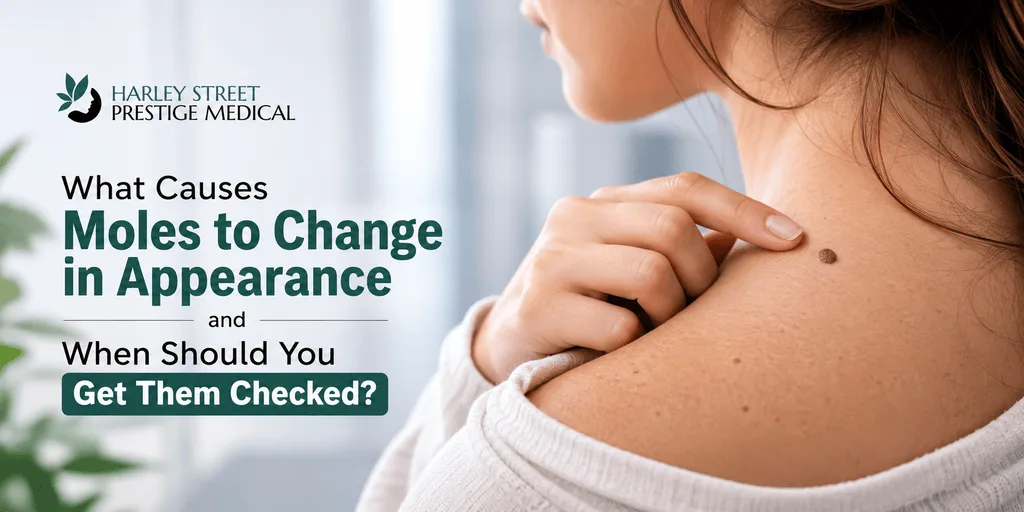
Moles, medically referred to as melanocytic naevi, are among the most common skin lesions encountered in clinical dermatology. Most adults have between 10 and 40 moles, and the vast majority remain completely benign throughout their lifetime. However, moles are not always static. They can naturally change in size, shape, colour, or texture, and while many of these changes are harmless, some may require prompt medical assessment.
At Harley Street Prestige Medical, we understand that noticing a changing mole can be concerning. Many of our patients ask whether a change is simply part of the skin’s natural ageing process or whether it could indicate an underlying condition that needs further investigation.
In this blog, we explain the common reasons why moles change in appearance, the warning signs you should never ignore, when it is appropriate to seek a professional mole assessment, and how the most appropriate mole removal treatment in London is determined based on your individual skin, the characteristics of the mole, and your clinical needs.
Understanding What a Mole Is
A mole, medically known as a melanocytic naevus, develops when specialised pigment-producing cells called melanocytes cluster together within the skin. These cells produce melanin, the pigment responsible for your skin colour.
Moles may:
- Be present from birth (congenital moles)
- Develop during childhood or adolescence
- Appear later in adulthood
- Vary in colour from light brown to dark brown or black
- Be flat or raised
- Occur anywhere on the body
Most adults have between 10 and 40 moles, and the majority remain stable throughout life.
Why Do Moles Change in Appearance?
Not every change in a mole is a cause for concern. Several natural and medical factors can influence how a mole looks over time.
Ageing
As we age, our skin naturally changes. Some moles gradually become raised, lighter in colour, or even disappear altogether. These age-related changes are generally harmless and occur slowly over many years.
Hormonal Changes
Hormonal fluctuations can affect melanocyte activity, making moles appear darker or larger.
These changes commonly occur during:
- Puberty
- Pregnancy
- Hormonal treatments
Although hormonal changes often explain temporary alterations, any mole that changes should still be examined by a qualified clinician.
Sun Exposure
Ultraviolet (UV) radiation stimulates melanin production. Excessive or repeated sun exposure can cause existing moles to darken and may contribute to the development of new moles.
Long-term UV damage is also one of the most important risk factors for skin cancer, making sun protection essential for maintaining healthy skin.
Friction and Repeated Trauma
Moles located in areas that experience constant rubbing, such as the neckline, waistband, underarms, or areas affected by shaving, may become irritated.
Repeated friction can cause:
- Inflammation
- Bleeding
- Crusting
- Temporary changes in appearance
Although irritation does not necessarily indicate cancer, persistent symptoms should always be assessed.
Benign Skin Changes
Some moles naturally evolve over time without becoming cancerous. They may become slightly larger, develop hair growth, or become more raised.
Only a professional examination can determine whether these changes are entirely benign.
When Should You Get a Mole Checked?
One of the most important aspects of skin health is recognising when a mole requires medical evaluation.
We recommend arranging a professional assessment if you notice any of the following:
- A mole increasing in size
- Changes in colour or multiple colours developing
- Irregular or poorly defined borders
- Changes in shape or asymmetry
- Bleeding without injury
- Persistent itching
- Crusting or ulceration
- Pain or tenderness
- A new mole appearing in adulthood
- A mole that looks noticeably different from your other moles
Early assessment allows appropriate investigation and, where necessary, timely treatment.
The ABCDE Rule for Assessing Moles
Dermatologists commonly use the ABCDE rule to identify features that may require further investigation.
- A – Asymmetry: One half of the mole does not match the other half.
- B – Border: The edges become irregular, blurred, or uneven.
- C – Colour: The mole develops different shades of brown, black, red, blue, or white.
- D – Diameter: A mole becomes larger than approximately 6 mm or continues to grow.
- E – Evolution: Any ongoing change in size, shape, colour, elevation, or symptoms is one of the most important warning signs.
While the ABCDE rule is a useful guide, not every concerning mole follows this pattern. This is why professional assessment remains essential.
Can a Changing Mole Mean Skin Cancer?
Most changing moles are not cancerous. However, some changes can be associated with melanoma, the most serious form of skin cancer.
Melanoma develops when melanocytes grow uncontrollably. Early detection improves treatment outcomes, making prompt assessment extremely important.
Risk factors include:
- Excessive ultraviolet exposure
- Fair skin
- A history of frequent sunburn
- Numerous moles
- Family history of melanoma
- Previous skin cancer
If there is any clinical concern during your consultation, your clinician will advise on the most appropriate next steps.
How Are Suspicious Moles Assessed?
Many patients searching for the best dermatologist in London are seeking reassurance that their skin concerns will be assessed thoroughly. At Harley Street Prestige Medical, every mole assessment begins with a comprehensive clinical consultation.
Your clinician will carefully evaluate:
- The appearance of the mole
- Its size, colour, and borders
- Your personal and family medical history
- Any recent changes
- Associated symptoms
Following examination, we will discuss whether the mole is suitable for monitoring, requires removal, or should be referred for further investigation. If removal is clinically appropriate, we will explain the most suitable mole removal treatment in London based on the characteristics of your lesion, your skin type, and your individual goals.
Our aim is to ensure every patient receives clear, evidence-based advice based on their individual circumstances.
Mole Removal Options
When removal is clinically appropriate or desired for cosmetic reasons, several treatment options may be considered.
Surgical Excision
Surgical excision remains the gold standard for definitive mole removal.
The procedure involves carefully removing the entire lesion under local anaesthetic while preserving the surrounding healthy tissue as much as possible.
Where clinically indicated, the removed tissue may be sent for histological analysis, allowing microscopic examination to confirm the diagnosis.
Shave Removal
Certain raised benign moles may be suitable for shave removal.
This technique can provide an excellent cosmetic result in carefully selected cases and usually involves a shorter recovery period.
Cryotherapy
Cryotherapy may be appropriate for selected benign skin lesions but is not suitable for all pigmented moles.
Suitability is determined following a detailed clinical assessment.
Our clinicians will always recommend the safest and most appropriate treatment based on your skin, the characteristics of the lesion, and your overall health.
What Happens During Your Appointment?
We understand that many patients feel anxious before having a mole assessed.
Our consultation process is designed to be thorough, informative, and reassuring.
Your appointment typically includes:
- A detailed discussion about your concerns
- Careful examination of the mole
- Explanation of the findings
- Discussion of available treatment options
- Same-day mole removal where clinically appropriate
- Comprehensive aftercare advice to support optimal healing and minimise scarring
Every treatment plan is personalised because no two patients or skin lesions are exactly alike.
Can Moles Be Prevented?
Although it is not possible to prevent every mole from developing, protecting your skin can reduce unnecessary damage and lower your risk of skin cancer.
We advise our patients to:
- Use broad-spectrum sunscreen daily
- Avoid excessive sun exposure, particularly during peak UV hours
- Wear protective clothing when outdoors
- Avoid tanning beds
- Perform regular skin self-examinations
- Arrange professional assessment for any new or changing lesions
Prevention and early detection remain the most effective strategies for maintaining healthy skin.
Why Patients Choose Harley Street Prestige Medical
Choosing the right clinic for mole assessment is an important decision. Many people looking for the best dermatologist in London prioritise clinical expertise, patient safety, clear communication, and evidence-based care. At Harley Street Prestige Medical, we are committed to providing comprehensive mole assessments in a professional Harley Street setting.
Located at 104 Harley Street, London, Harley Street Prestige Medical combines clinical expertise with patient-centred care in one of the UK’s most recognised medical districts.
Our experienced clinicians carefully assess every mole with attention to both medical safety and cosmetic outcomes. We provide personalised treatment recommendations based on the type of lesion, its location, your skin type, and your individual goals.
From your initial consultation through to aftercare, we are committed to delivering safe, evidence-based care in a professional and supportive environment.
Book Your Mole Assessment at Harley Street Prestige Medical
If you have noticed a mole changing in size, shape, colour, or texture, don’t ignore it. While many changes are harmless, a professional assessment is the safest way to understand what they mean and whether any further investigation or treatment is needed. Book your consultation today and take a proactive approach to your skin health with expert assessment and mole removal treatment in London at Harley Street Prestige Medical.

