

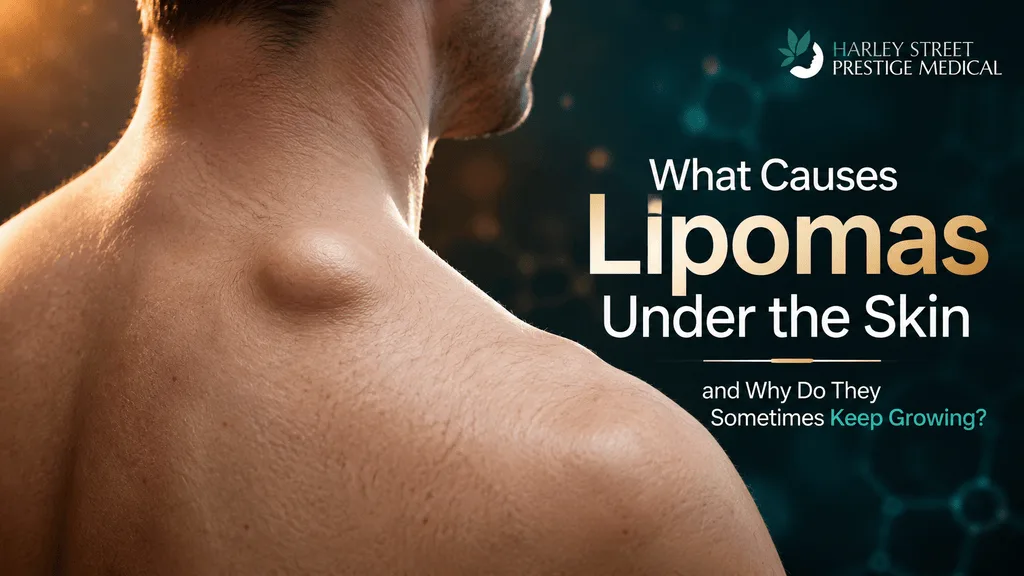
Medically reviewed by dermatology specialists at Harley Street Prestige Medical, London.
Discovering a lump beneath your skin can be unsettling. Even when it feels soft and painless, it’s natural to wonder why it has appeared, whether it will continue to grow, and if it could indicate something more serious.
At the Harley Street dermatology clinic in London, many patients come to us with the same concern: “Why has this lump developed, and why does it seem to be getting bigger?”
In many cases, these lumps are diagnosed as lipomas, which are benign growths made up of fat cells. While lipomas are generally harmless, understanding why they develop and what influences their growth can help you make informed decisions about your health and when to seek professional advice.
Why Do Lipomas Form Under the Skin?
Despite being one of the most common benign soft tissue growths, the exact cause of lipomas is not fully understood. Medical research suggests that several factors may contribute to their development.
Genetics Often Plays a Major Role
One of the strongest links to lipoma formation is family history.
Many people who develop lipomas have a close relative who has experienced similar growths. This suggests that certain individuals may inherit a tendency for fat cells to accumulate abnormally in localised areas beneath the skin.
If multiple members of your family have had lipomas, your risk of developing them may be higher than average.
Abnormal Growth of Fat Cells
Lipomas form when fat cells multiply in a confined area and create a soft lump beneath the skin.
Unlike normal body fat, which is distributed throughout the body, a lipoma develops as a distinct collection of adipose tissue. Medical experts believe that changes within these fat cells can trigger their gradual accumulation, resulting in a noticeable lump.
This process is usually slow and can occur over months or even years.
Age May Increase the Risk
Although lipomas can occur at any age, they are most commonly diagnosed in adults between 40 and 60 years old.
As the body ages, changes in tissue structure and fat distribution may contribute to the formation of these benign growths. However, younger adults and even children can occasionally develop lipomas as well.
Certain Medical Conditions Can Contribute
In some cases, multiple lipomas may be associated with inherited medical conditions such as Familial Multiple Lipomatosis.
These conditions are relatively rare but can cause numerous lipomas to develop across different parts of the body throughout a person’s lifetime.
This is one reason why specialist assessment is important, particularly if you notice multiple lumps appearing over time.
What Does a Lipoma Feel Like?
Most lipomas:
- Feel soft and rubbery
- Move slightly beneath the skin when pressed
- Grow slowly over time
- Are usually painless
- Commonly occur on the neck, shoulders, back, arms and thighs
However, not every lump has these characteristics, which is why professional assessment is recommended.
Why Do Some Lipomas Keep Growing?
One of the biggest misconceptions about lipomas is that they always remain the same size. While some stay small for years, others continue to enlarge gradually.
Lipomas Contain Living Fat Cells
A lipoma is not simply a static lump.
It consists of living fat cells that can continue to multiply slowly over time. As these cells increase in number, the lipoma may become larger and more noticeable.
This growth is usually gradual rather than sudden, which is why many patients only realise the lump has increased in size after several months or years.
Every Person’s Biology Is Different
Not all lipomas behave the same way.
Some remain stable and unchanged for decades, while others continue to expand. Factors such as genetics, tissue characteristics, and individual biological processes can all influence how a lipoma develops.
This variation explains why one person’s lipoma may remain small while another’s continues to enlarge over time.
Delaying Assessment Can Make Growth More Noticeable
Because lipomas are often painless, many people choose to ignore them initially.
Over time, however, a slowly growing lipoma can become more visible under clothing or begin to affect nearby tissues. What may have started as a small lump can gradually become a source of discomfort or self-consciousness.
Early assessment allows patients to understand what they are dealing with and discuss appropriate management options before the growth becomes more problematic.
When Should You Be Concerned About a Growing Lump?
While lipomas are usually benign, not every lump beneath the skin is a lipoma.
You should seek medical evaluation if a lump:
- Grows rapidly
- Becomes painful
- Feels hard or fixed in place
- Changes shape or appearance
- Causes numbness or restricted movement
- Becomes inflamed or tender
These symptoms do not necessarily indicate a serious condition, but they warrant professional assessment to establish an accurate diagnosis.
At Harley Street dermatology clinic in London, every patient undergoes a thorough clinical evaluation to ensure that the correct diagnosis is made before any treatment recommendations are provided.
Can a Lipoma Turn Into Cancer?
Lipomas are benign growths and do not usually become cancerous.
However, because some rare soft tissue tumours can initially resemble a lipoma, any lump that is rapidly enlarging, painful, firm, or changing in appearance should be assessed by a healthcare professional.
A clinical examination and, where appropriate, imaging or further investigations may be recommended to confirm the diagnosis.
Why Do People Choose Lipoma Removal Surgery?
Although lipomas are not usually dangerous, many patients choose lipoma removal surgery for practical and personal reasons.
Common reasons include:
- Cosmetic Improvement: Lipomas can become noticeable under clothing, particularly when located on the neck, shoulders, arms, or back. Many patients seek lipoma removal treatment in London to restore confidence and achieve a smoother appearance.
- Relief from Discomfort: Larger lipomas may press on surrounding structures, causing tenderness, irritation, or discomfort during daily activities. Removal can often provide immediate relief.
- Prevention of Further Growth: Many patients choose to undergo lipoma removal surgery before the lump increases in size and becomes more noticeable or challenging to manage.
- Diagnostic Reassurance: Removing and examining the tissue can provide additional reassurance and diagnostic clarity, particularly when there is uncertainty about the nature of the lump.
Peace of Mind: For many individuals, the greatest benefit is simply eliminating the ongoing worry associated with a persistent lump.
Specialist-Led Lipoma Removal Care You Can Trust
At Harley Street Prestige Medical, we understand that even a harmless lump can affect your confidence, comfort, and peace of mind.
Our specialist-led lipoma removal treatment in London combines clinical expertise with a patient-centred approach to care.
Patients benefit from:
- Comprehensive medical assessment and diagnosis
- GMC-registered surgical expertise
- More than 14 years of clinical experience
- Evidence-based treatment recommendations
- Precise surgical excision techniques
- Minimal-scarring surgical approaches
- Same-day treatment availability in many cases
- Dedicated aftercare and ongoing support
For more complex cases, our dermatology team is supported by experienced plastic surgeons to help achieve the best possible functional and cosmetic outcomes.
Contact Harley Street Prestige Medical today to arrange a specialist consultation and receive expert assessment and exceptional patient care from our highly experienced clinical team.

