

By Harley Street Prestige Medical Editorial Team | Medically Reviewed by Dermatology Specialists | June 2026
You notice a small, flesh-coloured bump in your intimate area. Naturally, your mind starts racing. Is it a harmless skin tag? Could it be a genital wart? Is it something contagious? Do you need treatment?
These questions are more common than many people realise. In fact, genital warts and skin tags are two of the most frequently confused skin growths seen in dermatology clinics. While they can look surprisingly similar, they have very different causes, health implications, and treatment requirements.
In this guide, the specialists at Harley Street Prestige Medical explain how to tell the difference between genital warts and skin tags, what warning signs to look for, and when it is important to seek professional medical assessment.
What Are Genital Warts?
Genital warts are benign epithelial growths caused by certain strains of the Human Papillomavirus (HPV), most commonly HPV types 6 and 11. They are among the most common sexually transmitted infections (STIs) worldwide.
These lesions develop on the genital, perineal, or anal regions and are transmitted primarily through direct skin-to-skin sexual contact. In some cases, the virus may remain dormant for months or even years before visible warts appear.
Common characteristics of genital warts:
- Soft, flesh-coloured, pink, or slightly darker growths
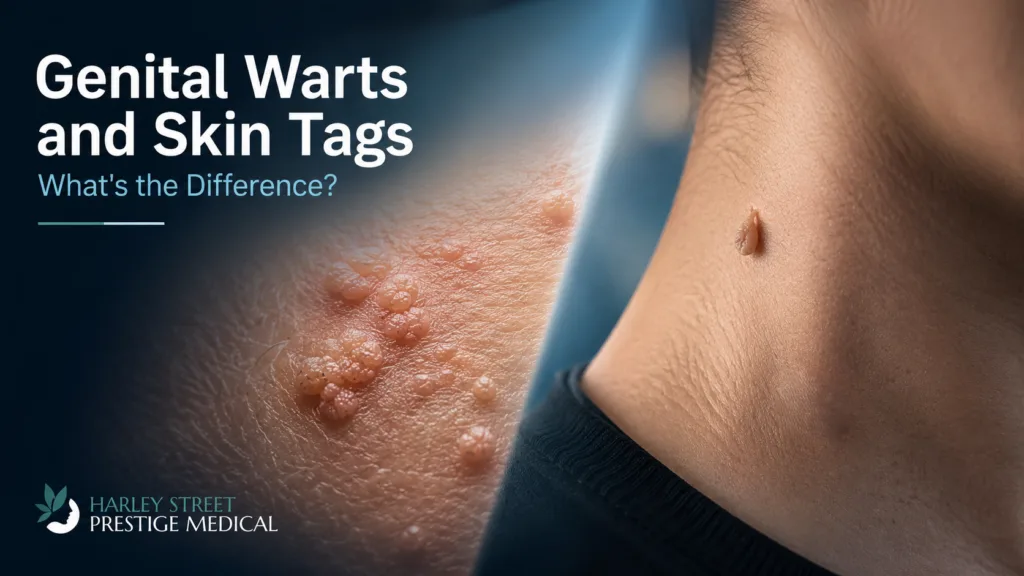
- Flat, raised, or cauliflower-like appearance
- May occur individually or in clusters
- Can develop on the penis, vulva, vagina, cervix, scrotum, groin, or around the anus
- Occasionally associated with itching, irritation, or discomfort
- May increase in size or number if left untreated
Although genital warts are generally not cancerous, they indicate an active HPV infection and can be transmitted to sexual partners.
What Are Skin Tags?
Skin tags, medically known as acrochordons, are common benign skin growths that develop due to friction and other non-infectious factors. They are composed of loose collagen fibres and small blood vessels enclosed within normal skin tissue.
Unlike genital warts, skin tags are not caused by a virus and are not contagious.
Common characteristics of skin tags:
- Soft, smooth, flesh-coloured growths
- Typically attached to the skin by a narrow stalk (peduncle)
- Usually painless
- Commonly found in areas of friction
- Range in size from a few millimetres to several centimetres
- Generally remain stable over time
Skin tags frequently develop on the neck, underarms, eyelids, groin, beneath the breasts, and other skin-fold areas where repetitive rubbing occurs.
Genital Warts vs Skin Tags: Key Differences
When comparing genital warts vs skin tags, it is important to understand that although these lesions may appear similar, they differ in their causes, appearance, transmission risk, and treatment requirements.
| Feature | Genital Warts | Skin Tags |
| Cause | Human Papillomavirus (HPV) infection | Friction, genetics, hormonal factors |
| Contagious | Yes | No |
| Transmission | Sexual skin-to-skin contact | Not transmissible |
| Appearance | Flat, raised, or cauliflower-like clusters | Smooth, soft growth attached by a stalk |
| Texture | Rough or uneven surface | Smooth and soft |
| Location | Genital and anal areas | Skin folds and friction-prone areas |
| Growth Pattern | May spread and multiply | Usually remain isolated |
| Associated Symptoms | Itching, irritation, discomfort | Usually asymptomatic |
| Medical Concern | STI requiring clinical assessment | Benign cosmetic concern |
While this comparison can be helpful, visual assessment alone is not always reliable. Certain skin tags can resemble genital warts, particularly when they occur in the groin or intimate regions.
Why Are Skin Tags Sometimes Confused with Genital Warts?
Many patients seek medical advice because they discover small flesh-coloured bumps in the genital area and fear they may have contracted an STI.
Several factors contribute to this confusion:
- Both conditions can appear as soft skin growths
- Both may occur in the groin region
- Early genital warts can be very small and subtle
- Skin tags in intimate areas may look unusual to patients unfamiliar with them
However, clinicians often identify important distinguishing features during examination. Skin tags generally have a smooth surface and a narrow stalk, whereas genital warts often display an irregular, rough, or clustered appearance.
Risk Factors for Genital Warts
Certain factors increase the likelihood of developing genital warts:
- Unprotected sexual activity
- Multiple sexual partners
- Previous HPV exposure
- Weakened immune system
- Early onset of sexual activity
Because HPV infection may remain dormant, patients are often surprised when genital warts appear despite having no recent symptoms or concerns.
Risk Factors for Skin Tags
Skin tags are associated with several non-infectious factors, including:
- Repeated skin friction
- Obesity
- Diabetes and insulin resistance
- Pregnancy
- Hormonal changes
- Increasing age
- Family history and genetic predisposition
These growths commonly develop in areas where skin rubs against skin or clothing over prolonged periods.
How Are These Conditions Diagnosed?
Accurate diagnosis begins with a thorough clinical examination performed by a qualified healthcare professional.
For genital warts, clinicians evaluate:
- Lesion appearance
- Distribution pattern
- Sexual health history
- Signs of active HPV infection
For skin tags, assessment focuses on:
- Morphological features
- Size and attachment pattern
- Changes in appearance
- Exclusion of other skin conditions
In uncertain cases, further investigation or histopathological examination may be recommended to confirm the diagnosis.
Treatment Options
At Harley Street skin care clinic, treatment is individually planned for each patient. Following a comprehensive assessment, our dermatology specialists recommend the most appropriate treatment approach based on the type, size, location, and characteristics of the lesion.
Genital Wart Treatment
Management depends on the size, number, and location of lesions. Common genital wart removal treatment in London options include:
- Surgical Excision (Gold Standard Treatment)
- Hyfrecation (Electrocautery Treatment)
- Cryotherapy (Freezing Treatment)
- Medical / Topical Treatments
The primary goals are removal of visible lesions, symptom relief, and reduction of transmission risk. Although treatment removes visible warts, HPV may persist within the body, making recurrence possible in some patients.
Skin Tag Removal
Skin tags are usually removed for cosmetic reasons or when they cause irritation. Common skin tag removal treatment in London options include:
- Excision Removal
- Hyfrecation (Electrosurgical Removal)
Once removed, the treated skin tag typically does not return, although new skin tags may develop elsewhere over time.
Why Professional Assessment Matters
Because genital warts and skin tags can appear similar, self-diagnosis is often unreliable. An accurate diagnosis requires clinical assessment by an experienced dermatologist or skin specialist. A professional examination helps distinguish benign skin tags from HPV-related genital warts and ensures that patients receive the most appropriate treatment.
At Harley Street skin care clinic, patients benefit from confidential consultations, specialist-led assessments, and personalised treatment plans designed to achieve accurate diagnosis and effective management of both genital warts and benign skin lesions.
When Should You See a Medical Professional?
You should seek medical evaluation if you notice:
- New growths in the genital region
- Lesions that increase in size or number
- Bleeding, pain, or irritation
- Changes in colour or texture
- Uncertainty about whether a lesion is a skin tag or wart
Early assessment can provide reassurance, establish an accurate diagnosis, and ensure appropriate treatment where necessary.
Concerned About a Skin Growth? Speak to a Specialist
At Harley Street Prestige Medical, our dermatology specialists provide confidential consultations, comprehensive skin assessments, and personalised treatment plans tailored to your individual needs.
As a leading dermatology clinic in London, we use advanced diagnostic expertise and evidence-based treatment options to help patients achieve accurate diagnoses and effective outcomes in a discreet, supportive clinical environment. Book your consultation today and receive expert-led care from experienced dermatology specialists dedicated to your skin health and wellbeing.

