

By the Harley Street Prestige Medical Editorial Team | Medically reviewed by our dermatology team | October 2026
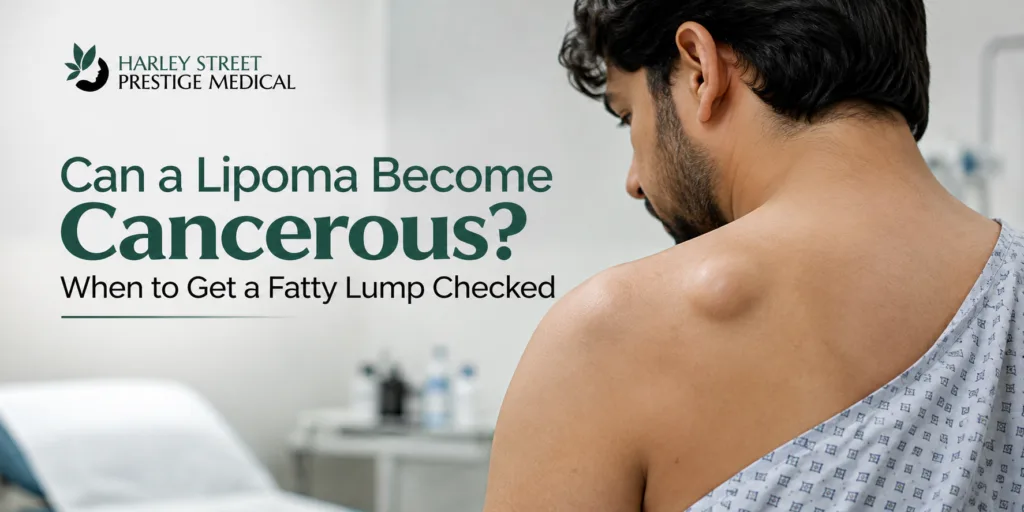
If you have found a soft lump beneath your skin, you may be wondering whether it could be cancerous and whether you need to see a doctor. The reassuring news is that a typical lipoma is a benign growth of fat cells and does not ordinarily turn into cancer. However, not every fatty lump is a lipoma, and some require further investigation. This guide explains which warning signs to look for, when to seek medical advice, and what to expect during diagnosis.
Quick Answer
- Lipomas are benign: A typical lipoma does not turn into cancer.
- Liposarcoma is different: This rare cancer develops in fatty tissue and is distinct from a benign lipoma.
- Know when to seek advice: Get a lump assessed if it is growing, around 5 cm or larger, deep, fixed, painful, or has returned after removal.
- Diagnosis matters: A doctor may recommend an examination, ultrasound, MRI, or biopsy, depending on the lump’s characteristics.
What Is a Lipoma?
A lipoma is a benign (non-cancerous) growth made up of mature fat cells that develops beneath the skin. It typically feels soft and is usually painless and slightly movable. Lipomas are common in adults and often appear on the back, shoulders, neck, arms, and thighs. They usually grow slowly and may remain unchanged for years.
Can a Lipoma Turn Into Cancer?
A typical lipoma does not turn into cancer. Lipomas are benign growths of mature fat cells, whereas liposarcoma is a rare malignant tumour that develops in fatty tissue. They are distinct conditions rather than different stages of the same disease.
Sometimes, a lump believed to be a lipoma may actually be an atypical lipomatous tumour (ALT), which can resemble a benign fatty lump during examination. This does not mean the lipoma has become cancerous; rather, the original diagnosis may need further investigation.
Most lipomas remain harmless. However, a lump that grows rapidly, feels deep or fixed, or recurs after removal should be assessed by a medical professional. Depending on the findings, an ultrasound, MRI, or biopsy may be recommended to establish the diagnosis.
If you are concerned about a fatty lump or would like to discuss its removal, an appropriately qualified clinician at Harley Street Prestige Medical can be a relevant starting point for an assessment and advice on suitable next steps.
What Is the Difference Between a Lipoma and Liposarcoma?
Lipomas and liposarcomas can both appear as fatty lumps beneath the skin, but they are different conditions. A lipoma is benign, whereas a liposarcoma is a rare cancer of soft tissue.
| Feature | Lipoma | Liposarcoma |
| Nature | Benign, non-cancerous | Malignant, cancerous |
| Growth | Usually slow-growing | May enlarge progressively |
| Location | Commonly beneath the skin | Often in deeper soft tissues |
| Feel | Often soft and mobile | May be deep or less mobile |
| Pain | Usually painless | May or may not be painful |
| Diagnosis | Clinical examination; further tests if needed | Imaging and sometimes biopsy |
| Treatment | Observation or removal if indicated | Specialist-led cancer treatment |
These features are general patterns, not definitive rules. A liposarcoma can be painless, and a benign lump can sometimes feel firm. A doctor’s assessment is therefore more reliable than assessing a lump by touch alone.
When Should You Get a Fatty Lump Checked?
Before considering treatment for lipoma removal, it is important to confirm that the lump is a lipoma. Most fatty lumps are benign, but certain features warrant medical assessment. Arrange an appointment if your lump:
- Measures approximately 5 cm or more: Larger lumps may require further investigation.
- Is growing: Noticeable or rapid growth should not be ignored.
- Feels deep or fixed: A lump that lies beneath the muscle or does not move easily needs assessment.
- Feels unusually firm or irregular: Its characteristics may indicate the need for further investigation.
- Causes persistent or worsening pain: Unexplained discomfort should be assessed.
- Returns after removal: A recurrent lump may require further examination.
These features do not automatically mean cancer. However, they help clinicians identify lumps that may need imaging or specialist assessment.
Do not wait for a lump to become painful. Some soft-tissue tumours are painless in their early stages. If your lump is growing or has other concerning features, seek medical advice promptly. Your doctor can determine whether an ultrasound, MRI, or specialist referral is appropriate.
How Is a Lipoma Diagnosed?
A doctor usually begins by examining the lump and asking when it appeared, whether it has grown, and whether it causes pain. They will assess its size, location, depth, consistency, and mobility.
If the lump has typical features of a lipoma, a clinical examination may be sufficient. If the diagnosis is uncertain, further tests may be recommended:
- Ultrasound: Assesses the lump’s size, depth, and structure.
- MRI scan: Provides detailed images of deeper or more complex lumps.
- Biopsy: A tissue sample may be needed if there is concern about a potentially serious condition.
- Histopathology: Examines tissue under a microscope to help establish the diagnosis.
Not every lipoma requires imaging or a biopsy. The appropriate approach depends on the clinical findings.
What Happens If Your Lump Needs Further Investigation?
If your doctor suspects that the lump may be something other than a lipoma, you may be referred to a specialist for further assessment. The next steps will depend on the examination findings and the results of any initial tests.
Further investigation does not automatically mean cancer. It helps your medical team clarify the diagnosis and determine whether monitoring, treatment, or specialist care is appropriate.
Does Every Lipoma Need to Be Removed?
No. A confirmed, harmless lipoma that is painless and not growing usually does not require treatment. However, removal may be recommended if it causes pain, increases in size, restricts movement, affects appearance, or requires further investigation.
The appropriate treatment for lipoma removal depends on the lump’s size, location, symptoms, and clinical assessment. Your doctor can explain whether surgical excision is suitable and discuss the potential benefits, risks, and recovery process.
Avoid squeezing or attempting to remove a lipoma yourself, as this can cause infection, bleeding, and tissue damage.
How Does Lipoma Removal Surgery Work?
When removal is appropriate, a common treatment for lipoma removal is surgical excision. This procedure involves removing the lipoma through an incision in the skin.
At Harley Street Prestige Medical, the procedure may involve the following stages, depending on the size and location of the lump and the individual treatment plan.
Local anaesthesia
For suitable superficial lipomas, local anaesthesia is used to numb the treatment area. You remain awake while the area is made comfortable for the procedure.
A carefully planned incision
The doctor makes an incision over the lump, taking its position and the desired cosmetic outcome into account.
Removal of the lipoma
The surgeon separates the fatty tissue from the surrounding structures and removes it. Where appropriate, complete excision includes removing the surrounding capsule.
Wound closure
The incision is closed with sutures, selected according to the wound and the surgical technique used.
Aftercare and recovery
Most straightforward superficial lipoma excisions are performed as day procedures. You can generally return home afterwards, with recovery time depending on the size and location of the wound. Your clinician will explain how to care for the incision, when to attend follow-up appointments, and when you can resume normal activities.
Can a Lipoma Come Back After Removal?
Yes, a lipoma can recur after surgery, although recurrence is generally uncommon when the lump is completely removed. If some of the lipoma remains, it may grow again. A separate lipoma may also develop in the same area.
Complete surgical excision can reduce the risk of recurrence, but it cannot eliminate it entirely. If you notice a new lump or swelling in the same area after surgery, seek medical assessment to determine the cause.
Where Can You Get Lipoma Removal in London?
At Harley Street Prestige Medical, patients can access specialist-led lipoma assessment and surgical removal in London. Our approach prioritises accurate diagnosis, personalised treatment planning, and clinical and cosmetic outcomes.
If you are looking for a cosmetic dermatologist in Harley Street to assess a fatty lump, book a consultation to discuss your concerns, suitable treatment options, recovery, and potential risks with our medical team.
The most appropriate treatment will depend on the clinical assessment and whether the lump has been confirmed as a lipoma.
Medical note: This article is intended for general educational purposes and does not replace an individual medical assessment. Diagnosis and treatment decisions should be made with a qualified healthcare professional.
Frequently Asked Questions
Can a small lipoma be cancerous?
A typical lipoma is benign, regardless of whether it is small or large. However, size alone cannot confirm the nature of a lump, so an unexplained or changing lump should be assessed.
Can a lipoma disappear on its own?
Lipomas generally do not disappear without treatment. If a confirmed lipoma is not causing problems, it can often be monitored rather than removed.
Should I get a painless lump checked?
Yes. Although most lipomas are painless, some concerning soft-tissue tumours can also develop without pain. Seek medical advice if a lump is new, growing, deep, fixed, or otherwise unusual.
Is lipoma removal always necessary?
No. A confirmed, asymptomatic lipoma often does not require removal. Surgery may be considered if it causes discomfort, grows, affects movement or appearance, or needs further investigation.
Medical References
- Cancer Research UK: Soft tissue sarcoma symptoms
- UK guidance: Management of soft tissue sarcomas

