

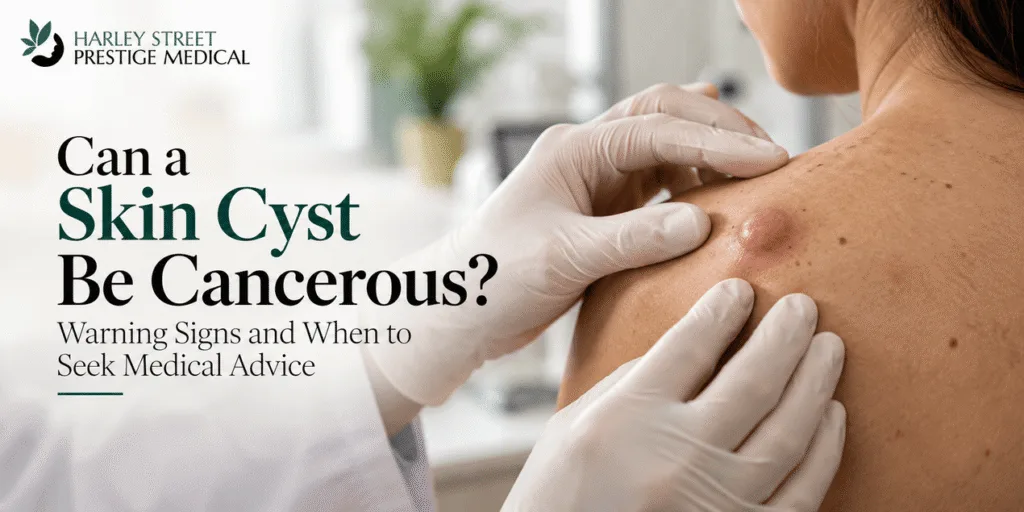
By the Harley Street Prestige Medical Editorial Team | Medically reviewed by our dermatology team | September 2026
If you have discovered a cyst or have been told you have one, wondering whether it could be cancerous is often one of the first concerns that comes to mind. It is a completely understandable worry.
At Harley Street Prestige Medical, we are here to help you understand your condition, provide expert assessment, and guide you towards the most suitable cyst removal treatment options if needed.
What Is a Skin Cyst?
A skin cyst is a closed sac that develops beneath the skin and may contain fluid, keratin (a protein found in skin cells), or other semi-solid material. Cysts usually form when skin cells, hair follicles, or natural skin structures become blocked.
Common types of skin cysts include:
- Epidermoid cysts: The most common type, these cysts develop when skin cells become trapped beneath the surface. These are sometimes incorrectly called “sebaceous cysts.” Patients often search for sebaceous cyst removal when looking for treatment options for this condition.
- Pilar cysts: Pilar cysts are typically found on the scalp and originate from hair follicles. These are also commonly known as a scalp cyst due to their frequent occurrence on the head.
- Pilonidal cysts: Usually occurring near the tailbone and sometimes become painful or infected.
- Dermoid cysts: Dermoid cysts are less common and may contain skin structures such as hair follicles or fatty tissue.
Most cysts grow slowly and remain harmless. They may stay unchanged for years or may gradually increase in size. However, changes in a cyst should always be evaluated rather than ignored.
Can Cysts Become Cancerous?
Typical skin cysts are benign (non-cancerous). Very rarely, malignant change has been reported within certain types of cyst, and some skin cancers or other abnormal growths can resemble cysts. This is why a new, changing or unusual lump should be professionally assessed rather than self-diagnosed.
A dermatologist can examine the lesion and determine whether it is consistent with a benign cyst or whether further investigation is appropriate. In some cases, further testing such as a biopsy may be recommended to confirm the diagnosis.
At Harley Street Prestige Medical, our dermatology specialists focus on accurate evaluation before recommending any treatment. This ensures patients receive the right care based on their individual condition.
Warning Signs That a Skin Lump Needs Medical Assessment
Although most cysts are harmless, certain changes may indicate that a medical review is needed.
You should seek advice from a dermatologist if your cyst:
Changes in Size or Growth Pattern
A cyst that grows rapidly or changes over a short period should be assessed. Slow growth is common with many benign cysts, but rapid enlargement requires careful evaluation.
Becomes Painful, Red, or Inflamed
Pain, redness, warmth, or swelling may indicate inflammation or infection. An infected skin cyst may require medical treatment before or alongside removal.
A painful skin cyst should not be ignored, especially if symptoms continue or become worse.
Changes in Colour or Appearance
Any noticeable change in colour, irregular borders, bleeding, or changes to the surface of a lump should be reviewed by a healthcare professional.
Feels Hard, Fixed, or Irregular
Most cysts are soft or mobile beneath the skin. A lump that feels unusually firm, appears attached to deeper tissues, or differs from your usual skin changes may require further investigation.
Does Not Heal or Continues to Reappear
A persistent lump that repeatedly becomes inflamed or returns after treatment should be assessed to identify the underlying cause.
How Dermatologists Diagnose Skin Cysts
A proper diagnosis is the first step towards effective treatment.
During a consultation, a dermatologist in Harley Street will typically:
- Review your medical history
- Examine the lump’s size, shape, location, and appearance
- Assess symptoms such as pain, discharge, or changes over time
- Determine whether further investigation is needed
In many cases, experienced dermatologists can identify common cysts through clinical examination alone. If there is any uncertainty, additional investigations may be recommended to confirm the diagnosis.
Receiving a professional assessment can provide reassurance and help answer concerns such as “are skin cysts dangerous?”
This information is intended for general guidance and does not replace an in-person medical assessment.
When Is Skin Cyst Removal Recommended?
Not every cyst needs to be removed. If a cyst is small, harmless, and not causing symptoms, monitoring may be appropriate.
However, cyst removal may be recommended when the cyst:
- Becomes repeatedly inflamed or infected
- Continues growing
- Causes discomfort or irritation
- Affects appearance or confidence
- Is located in a sensitive or visible area
At Harley Street Prestige Medical, cyst removal surgery in London is performed using precise techniques designed to safely remove the cyst while achieving favourable cosmetic results.
How Cyst Removal Surgery Works
Professional cyst removal is usually a minor procedure performed under local anaesthetic. The treatment area is numbed to ensure patient comfort throughout.
The preferred method is complete excision, where the cyst and its surrounding capsule are carefully removed.
The procedure generally involves:
1. Applying local anaesthetic to numb the area
2. Creating a small, controlled incision
3. Removing the cyst and capsule
4. Closing the area with appropriate sutures
Removing the complete cyst wall is important because leaving part of the capsule behind may increase the chance of recurrence.
For infected or inflamed cysts, drainage may sometimes be required first to reduce discomfort and allow the area to settle before complete removal.
Recovery After Cyst Removal
Recovery after cyst removal is usually simple. Most patients return to normal daily activities shortly after the procedure.
Temporary effects may include:
- Mild swelling
- Tenderness around the treated area
- Minor bruising
Following your dermatologist’s aftercare instructions can support proper healing and help minimise visible scarring.
At Harley Street Prestige Medical, we provide detailed aftercare guidance and ongoing support to help patients achieve the best possible recovery.
Why Choose Harley Street Prestige Medical for Cyst Removal Surgery In London?
Choosing the right specialist for cyst assessment and removal is important, particularly when you want both medical safety and cosmetic consideration.
At Harley Street Prestige Medical, patients benefit from:
- Experienced dermatology specialists
- Careful diagnosis before treatment
- Evidence-based cyst removal techniques
- A focus on minimal scarring
- Personalised treatment plans
- Professional aftercare support
When Should You Book a Dermatology Consultation?
If you notice a new lump, a changing cyst, or a skin growth that concerns you, seeking professional advice is the best way to understand what it is and whether treatment is needed.
Most skin cysts are harmless, but getting an accurate diagnosis can provide reassurance and ensure that any concerning changes are identified early.
At Harley Street Prestige Medical, the best cosmetic dermatologist in London is here to assess your skin concern and recommend the most appropriate next steps, whether this involves monitoring, further investigation or treatment.
If you have a persistent skin cyst or are concerned about changes in a lump, you can book a consultation with our Harley Street dermatology team for expert advice and personalised care.
People Also Ask About Skin Cysts
How can I treat a skin cyst?
Treatment depends on the cyst type. Some need monitoring, while others may require professional removal if they become painful, infected, or enlarged.
How will I know if my cyst is cancerous?
Most cysts are harmless. Rapid growth, unusual changes, bleeding, or a firm, fixed lump should be checked by a dermatologist.
What causes cysts in the body?
Cysts can develop due to blocked hair follicles, trapped skin cells, inflammation, or natural changes in the skin.
Do skin cysts go away on their own?
Most skin cysts do not disappear completely on their own, although some may remain small and harmless for years.
Is a cancerous cyst hard or soft?
Texture alone cannot identify cancer. Any unusual or changing lump requires professional evaluation.

